2. Project Lifecycle
- 2.1 What a project is in Easy Redmine
- 2.2 Project settings
- 2.3 Project overview
- 2.4 Project lifecycle (Project Lifecycle)
- 2.5 Project building blocks (components / elements of the project)
- 2.6 Project templates (Project Templates)
This manual refers to Easy Redmine and Easy Project. The functionality of the programs is identical, which is why the names “Easy Redmine” and “Easy Project” are used synonymously here.
Now that the application has been set up and configured, we can look at the impact of the settings and, above all, at the actual project work.
In the following chapters, we will take a top-down journey from the highest level – the projects – through the issues down to the individual time entries.
2.1 What a project is in Easy Redmine
2.1.1 Basic project and project management terminology
The terminology remains largely identical to versions 12 and 13. Even in version 14, it is possible to define projects without a start or end date. This flexibility does not always correspond to classical PM theory, but it remains useful due to configurability.
2.1.2 Project attributes
The central attributes still exist: name, parent project, description, start/due date, public visibility, planned status, custom fields, modules, issue types, etc. The logic for membership inheritance, private comments and custom fields remains in place.
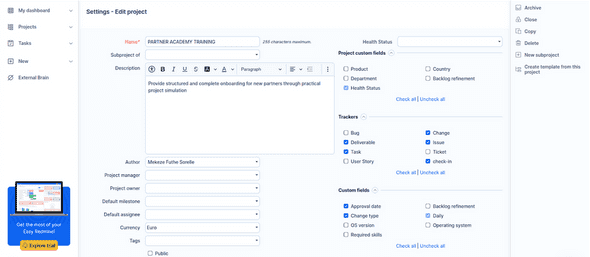
Name
The name of the project serves for unique identification and is displayed throughout the user interface.
Subproject of
This entry defines whether the current project is a subproject of another project. This creates a hierarchical structure between projects. The parent project can aggregate issues, resources, or reports from several subprojects.
Description
A text area to explain the content of the project, its goals, requirements or other important information.
Start date / Due date
Indicates the planned project period. These dates help with scheduling and in Gantt charts.
Public visibility
Determines whether the project is visible to all users or only to project members. Public projects are visible to everyone.
Planned status (status: planned / active / closed)
Indicates which phase the project is in. This helps with filtering and organizing projects.
Custom fields
Allow you to store additional project-specific information that goes beyond the standard attributes (e.g. customer number, budget).
Modules
Here you define which functions (e.g. issues, time reports, wiki, documents) are available in the project. Modules can be enabled or disabled depending on project needs.
Issue types
Define the categories of issues in the project, e.g. “Feature”, “Bug”, “Support”. Each type can be configured with its own workflows and fields.
Additional notes
Inheritance of memberships
Members and their roles in parent projects can be inherited by subprojects. This ensures that access rights remain consistent.
Private comments
Comments on issues can be marked as “private”, so they are only visible to certain users (or groups), e.g. only project managers or admins.
Custom fields (still valid)
These fields retain their validity and functionality from previous versions, with continued flexible adjustability per project.
New in version 14:
- One-click project status: The project status can be retrieved automatically based on issues, comments, etc. This clever AI-powered assistant analyses project data, task updates, meeting notes, and comments to produce comprehensive summaries of project activities. The main benefit of AI Project Status is analysis and reporting directly into your project management process, helping you maintain clear visibility of your project's progress and make data-driven decisions. Again, this AI assistant will be the "best buddy" of the project managers.
- Improved performance for attachments: For issues with many attachments, only the most recent ones are initially displayed, with a “Load more” function for additional attachments.
- Higher usability in the user profile: Menu behavior, submenus, and profile popups have been made more intuitive.
2.2 Project settings
After creating the project, you are taken to the project settings page, where you will find some additional options. To make it easier to set up future projects, there is the option of creating project templates – more on this in chapter 2.6.
We will now explain all the important options within projects so that you are prepared for all eventualities. To access the menu, move the mouse over the gear icon in the upper right corner when you are inside the project.
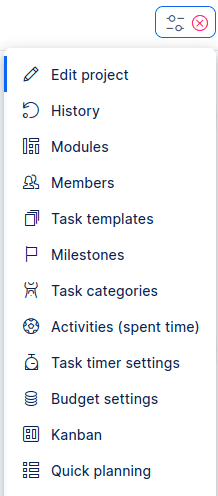
Edit project
In this section, you can manage the central attributes of your project, such as name, description, start and end date, and the visibility of the project. In addition, you can configure custom fields, enable or disable modules, and define issue types. Changes to these settings directly affect the structure and functionality of your project.
History
In this section, you will find a log of changes to the project attributes as well as comments written on the project for important announcements or changes. These comments can also be displayed on the project overview page.
Modules
Apart from the regular modules to enable/disable, you can also define the default project page here, i.e., when you open the project, you first land on this page. You can also reorder the items in the project menu for maximum convenience by checking Has a custom menu?.
Members
Adding/removing/editing memberships is intuitive, but there are a few principles you need to keep in mind.
- Inherited memberships cannot be changed – as explained in the previous chapter. You see these checkboxes greyed out.
-
Group memberships
- If you add a group as a member, all members of that group are added to the project.
- It is not possible to remove project members from the project if they belong to a group in that project.
- It is possible to assign additional roles to group members.
- When users are added to a group, they are added as members to all projects in which the group is a member.
- Group members who are removed from a group are removed from all projects in which the group is entered as a member.
- If project members have been assigned another role in the project individually, they remain in that role in the project even if the group is removed.
- You can manage memberships and roles only based on the permissions of your own role (chapter 1.2.7).
Milestones
Milestones are important points in the project plan. Here you see a simple list of milestones and options to create, edit or delete milestones.
The best way to create and edit milestones is in the Gantt chart, where they are displayed clearly together with the underlying issues.
Here are some recommendations and general information on the use of milestones:
- Do not use shared milestones for all projects when you use project templates – if there is only one shared milestone for all projects, this can lead to seemingly random shifts in issue and project dates when you create new projects from templates.
- To change the status of a milestone, click the milestone and then Edit.
- Open – issues can be added to the milestone.
- Locked – the milestone is still open, but you cannot add new issues under it.
- Closed – all issues are done and the milestone is thus completed and can be hidden.
In the project’s module bar, milestones are listed under Roadmap, which symbolizes the path marked by the milestones. The Roadmap menu item appears as soon as a milestone has been created.
The agile modules Scrum and Kanban have been functionally extended and made more user-friendly. Empty swimlanes are now automatically hidden, which improves clarity. Boards can be integrated more individually into dashboards, including new widgets and flexible display options. Issues can be edited directly on the board via the Quick Task Editor, without leaving the page. In addition, performance and loading times for large boards have been optimized, and there are more configuration options for card appearance and automatic status updates when moving issues.
Activities (Spent time)
Right with the first setting, an important decision must be made.
- Activity is selected when creating an issue (or when editing an issue) means that the author of the issue decides which activity is used for the spent time logged on this issue; project members who log time on the issue only enter the hours without selecting the activity. This setting makes time tracking easier for project members, but it makes issue creation more complex (one more attribute must be selected). If you initially used the other option and later switch to this one, updating issues that were created without a selected activity will also become more difficult – the person who updates them must select the activity during the next update. This option is useful if new issues are created only by one person who controls all project operations.
- Activity is selected during the time entry – You should definitely choose this option if several project members can create issues in this project.
In addition, it is possible to enable/disable activities for time tracking in this project to simplify the process a bit.
Based on a global setting (chapter 1.3.1 – Assign activities to roles) you will see a matrix of roles and activities that you can configure to define which roles can log time for which activities. These settings are very complex but can significantly simplify evaluations and overviews later on.
Task timer settings
These settings are identical to the global task timer settings (chapter 1.5.4). The difference is that here you have the option to override the global settings if you decide that behavior in this project should differ from the rest of the system.
New in version 14: see also https://www.easyproject.com/blog/easy-project-14-powered-by-ai
- Improved project templates and template integration: Creating and using project templates has become more intuitive. You can more easily define existing projects as templates, and when creating a new project from a template, more elements are taken over automatically.
- Comment functions & reactions: Comments can now be enriched with reactions (emojis), which speeds up feedback loops and makes less formal messages unnecessary.
- Optimized attachment loading behavior: For issues with many attachments, the system initially loads only the most recent ones; older attachments can be accessed via “Load more” to improve performance and loading times.
- Accessibility & UI improvements: High contrast mode, better support for screen readers, keyboard navigation have been improved, as well as smaller UX optimizations in the profile menu and submenus.
2.3 Project overview
The project overview remains modular (project description, project team, history, information, issues from filter).
New:
- Embedding dashboards directly into the project overview.
- Linking with agile boards (Scrum, Kanban).
- Direct access to the Jump to Dashboards function for quick switching between views.
Here is an example of a project overview page. It follows the principles explained in the previous chapters. Consider it a recommendation for the beginning, which you can later adapt according to your own practice.
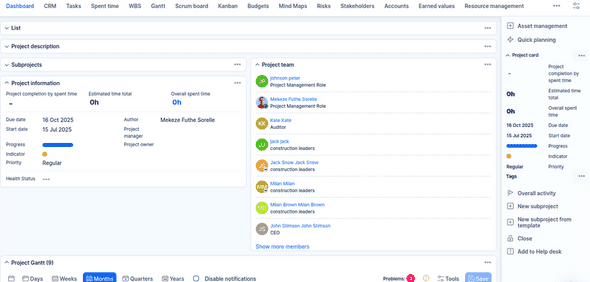
Project team / Project history
This name indicates that the module is also optimized for placement in the right sidebar area of the project overview if you want to put it there. The larger area on the left side, as in our example, is more prominent and better suited if you have multiple project teams and it is important to present the project staff.
If you are a smaller company and the team is practically identical across all projects, you can replace this module with Project history, which is found under the Projects group. It shows the comments/updates made on the project by the responsible staff (entered via Settings > History).
Information
This shows the most important information about project progress, including completion based on spent vs. estimated hours and completion resulting from the progress of each issue, weighted by its estimated time. The indicator shows whether there are any problems:
- Red – project is past its due date
- Orange – at least one issue is past its due date
New in version 14:
- Personal dashboard widgets: The project overview can now be personalized more strongly (e.g., which widgets are shown, saved filter settings, preferred sorting).
- Improved search & navigation: New search function that works faster, with a preview, a popup result window, and a search with more options and tooltips.
2.4 Project lifecycle (Project Lifecycle)
From the project perspective, the lifecycle of a model project looks like this: Planning, Execution, Closure, Archiving, (Deletion). We strongly recommend never deleting a project that contains production data. Archiving is the safer option.
Planning
Managers prepare issues, backlogs and schedules. In version 13, this phase is more strongly supported through the integration of new tools such as Scrum Backlog Planning or Custom Kanban Boards.
Execution
The active phase in which team members work on issues, log time and exchange files.
- In classic projects, the workflow remains as before.
- In agile projects, version 13 supports execution through team sprint boards with swimlanes (Scrum-compliant).
Closure
By closing a project, it is put into read-only mode. Data remains visible and searchable but can no longer be modified. Recommendation: keep projects in closed status for a few months before archiving them.
Archiving
Archived projects are invisible and can only be accessed via: Administration > Projects > Archived projects. Time entries remain available for reporting.
Deletion
Deleted projects are first archived and then permanently removed. Restoring is not possible after final deletion.
New in version 14:
- Project status updated automatically: Status changes in the project lifecycle are supported by automated reports and evaluation of task steps.
- Hybrid management support: Option to combine agile and traditional (waterfall) methods within a single project – matching the lifecycle and methodology of the project.
2.5 Project building blocks (components / elements of the project)
New in version 14:
- Task templates: Reusable issues with predefined fields, description, priority etc., which can be inserted quickly into new issues. Templates can be created from existing issues.
- Comments with reactions (emojis): Comments on issues can be given reactions to provide feedback without writing new comments.
- Attachment performance on issues: When displaying issues with many attachments, only the newest 25 attachments are loaded initially; older ones can be loaded via “Load more”, which significantly improves loading time.
2.6 Project templates (Project Templates)
Project templates are one of the most important time-savers in the application. Although every project is unique, there are often parts that many projects have in common.
The uniqueness lies in the content of the project, such as duration, goal, difficulty, end product, scope, etc. The form can be the same for projects of the same type, e.g. house construction, market research, product development, etc.
A project template can be preplanned with predefined issues and milestones in a general form and with the entire project team. When you create a real project from this template, you enter all details and re-plan it.
2.6.1 How to create a template
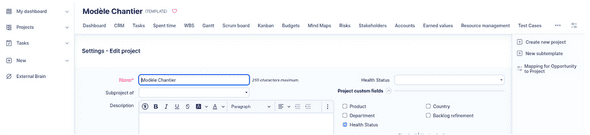
Go to an existing project: Settings > Information > Create template from this project. If the project contains subprojects, they also become part of the template.
Project templates are displayed in a separate list, which you can find under: Administration > Project templates.
Non-administrators can find them under the menu item: Projects > Create project from template – this first leads you to the template list.
You can recognize that you are currently in a template by an indicator next to the project name (TEMPLATE).

New in version 14:
- Faster creation of projects from templates: Projects can be created very quickly from fully equipped templates – including team, roles, issues, milestones and documents.
- More automation: When creating a new project, more is transferred automatically (e.g. default roles, modules, settings from the template).
- Import/export of templates: Project templates can be imported or exported, which helps to use standard templates across different instances/teams.

2.7 Project portfolio
2.7.1 Global Gantt
Similar to issue management, but on a larger scale, the most powerful tool for portfolio management is the Gantt chart. While the Gantt chart in the view of a single project provides issue-related functions, in this global Gantt chart you will find tools for portfolio management.
The global Gantt is accessible via the menu (three dots next to the profile) > Gantt. It allows you to: visualize completion progress in relation to planned progress (today), move entire projects in time, quickly filter delayed projects, display in each project the name of the issue that delays the project the most, break down the view into milestones and issues, display resource allocations from Easy Redmine / Easy Project Business Plan, and, of course, export the chart.
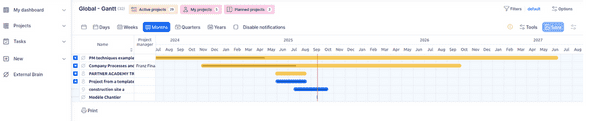
We are often asked about missing features in the global Gantt that exist in the project Gantt (e.g. creating new issues or displaying issue fields in the list). It is possible to see issues in the global Gantt as well, but there are technical limitations for issue operations and listings, as this view sits above the projects and not directly over the issues. Moreover, it is not best practice for portfolio managers to manage specific issues in detail in the portfolio overview.
A detailed manual for Gantt can be found in our online knowledge base: https://www.easyredmine.com/documentation-of-easy-redmine/article/easy-gantt-pro
2.7.2 Project list (tree)
The standard project list can be used for reports, summaries, or to find a specific project at a deeper level in the structure.
The project list is found via the main menu item Projects, if a user type has it enabled (chapter 1.1.6). We should clarify some details that distinguish the project list from other lists and which are often misunderstood.
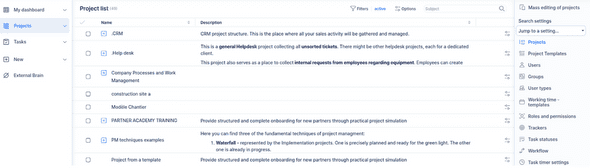
- If you do not define a specific sorting order, projects are sorted in a tree structure. This means you first see the top-level projects, which you can then expand to see their subprojects.
- When using filters in a tree view, results may appear that do not match the filter. The reason is that you also need to display their parent projects in order to show the relevant projects.
- Sorting and filtering projects by start/due date is only possible if you disable calculation of project dates – i.e., you enter the start/due date manually (chapter 1.3.1).
- It is not possible to have the tree view fully expanded by default or to expand all projects with a single button, as this would place too heavy a load on the hardware with a large number of projects.
New in version 14:
- Portfolio Manager Dashboard: Improved dashboards for portfolios: portfolio tree, key KPIs, graphs/charts to visualize performance across multiple projects.
- Better resource utilization & budget control: Tools for displaying utilization, current budgets, sprints, etc. at portfolio level.